How to Choose Wildfire Water Solutions for Global Buyers?
Wildfires are no longer a distant seasonal concern. They are becoming more frequent, intense, and costly across several regions. UNEP’s Spreading like Wildfire: The Rising Threat of Extraordinary Landscape Fires report projects extreme wildfire events could increase by 14% by 2030, 30% by 2050, and 50% by 2100. This changing risk makes reliable wildfire water solutions important for municipalities, industrial sites, farms, and property developers.
A practical buying decision begins with the fire environment. Water availability, terrain, storage capacity, pump performance, filtration, hose distance, and power supply all affect real protection. NFPA 1140 offers a recognized framework for wildland fire protection, while the Insurance Institute for Business & Home Safety emphasizes defensible space and building-level risk reduction. Buyers should not judge equipment by flow rate alone. A powerful pump is useless when its intake clogs with ash or its fuel supply fails during an outage. Small details matter.
The best solution is site-specific. A remote facility may need a portable tank, diesel pump, and long-range hose system. An urban project may require fixed storage, automatic controls, and dependable hydrant integration. The World Meteorological Organization’s State of the Global Climate reports reinforce the need for stronger climate resilience planning. Yet, global data remains uneven. That is a limitation worth admitting. Buyers should request tested performance data, service records, installation guidance, and local compliance evidence. The cheapest system may become the most expensive during a dry, windy afternoon. Reliability must be measured in real conditions, not only on a product sheet.
Understanding Wildfire Water Solutions and Their Core Functions
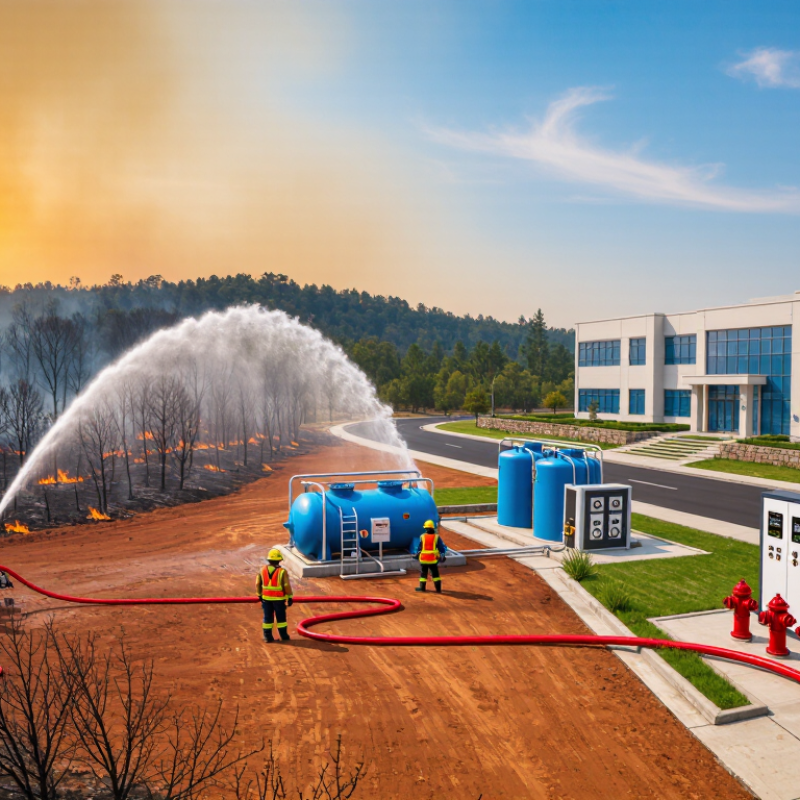
Wildfire water solutions are designed to slow flames and protect buildings, workers, and nearby vegetation. Their core function is simple: deliver enough water, at the right pressure, during extreme heat and wind. A complete setup may include storage tanks, pumps, hoses, hydrants, sprinklers, valves, and monitoring sensors. Storage tanks provide reserve capacity when municipal supplies become unreliable. Pumps maintain pressure across uneven terrain and long pipe runs. Hoses and hydrants support fast manual response. Sprinkler lines wet roofs, walls, and exposed fuel zones. Filtration matters when water comes from ponds or temporary sources. Small details matter.
Global buyers should evaluate the whole system, not one component. Start with local fire codes, water availability, terrain, and seasonal weather data. Then check flow rate, pump capacity, tank material, connection types, and backup power. Ask for test records, installation guidance, and maintenance schedules. Experienced fire engineers can verify whether stated performance matches site conditions. Materials must tolerate ultraviolet exposure, freezing temperatures, corrosion, and repeated use. Salt air can be harsh. Remote locations also need simple controls and accessible replacement parts. Yet specifications alone are not enough. No setup is perfect. I would question plans that ignore operator training or emergency access. Real sites reveal problems that drawings miss. Water demand may be underestimated, especially when several zones operate together. Buyers should review these assumptions with local responders and test the system under realistic conditions.
Assessing Regional Wildfire Risks and Water-Supply Requirements
Wildfire water needs vary sharply by region. A dry Mediterranean hillside may face fast, wind-driven flames and limited reservoirs. A northern forest may have deeper water sources but poor road access. Buyers should examine fire history, drought trends, vegetation, slope, wind patterns, and seasonal access before selecting equipment. Local fire authorities and hydrology professionals can verify these assumptions.
Water demand depends on the site, not only its size. A rural warehouse may require storage tanks, high-pressure pumps, and hose systems because hydrants are absent. A remote housing project may need portable tanks, water tenders, and reinforced access roads. Check source flow, pressure, refill time, water quality, and freezing risk. Saltwater can damage components. Sediment can block pumps. Small details matter.
Use field tests, not only supplier charts. Measure flow during dry periods and inspect roads with a loaded vehicle. Ask whether local crews can operate and maintain the system. No plan is perfect. A model may overlook a broken bridge or a well that weakens in August. That weakness deserves attention. Regional compliance requirements, emergency response times, and maintenance skills should shape the final purchase. A flexible system is often more useful than the largest system.
Evaluating Compliance, Reliability, Cost, and Environmental Impact
Choosing wildfire water solutions requires more than comparing pump capacity or storage volume.
Global buyers should verify compliance with local fire, water, transport, and environmental requirements. Request current test reports, material declarations, installation guidance, and maintenance records. Documents should be traceable and easy to review.
Reliability matters under heat, dust, freezing conditions, and poor road access. Check flow performance, backup power, corrosion resistance, spare-part availability, and technician support.
A system that performs well in a factory may struggle beside a dry forest. Cost should include delivery, installation, inspections, energy use, repairs, and water replenishment. The lowest quotation can become expensive after one difficult season.
However, every prediction has limits. Weather, terrain, and emergency access can change quickly.
Tips:
Compare full-life costs, not purchase prices. Ask for field references from similar climates. Test alarms, valves, pumps, and tanks before peak fire season. Choose recyclable materials where practical, and prevent leaks near soil or waterways. Reused water may reduce pressure on local supplies, but its quality must suit the equipment. Suppliers should explain treatment needs clearly. Buyers should also measure noise, fuel consumption, and routine waste. No option is perfect. A transparent review is safer than an impressive brochure.
Selecting Suppliers and Building a Scalable Global Procurement Plan
How to Choose Wildfire Water Solutions for Global Buyers?
Selecting suppliers requires more than comparing pump prices. UNEP’s 2022 report, Spreading like Wildfire, projects extreme wildfire events could rise by 14% by 2030 and 30% by 2050. Buyers therefore need equipment that performs across dry plains, steep forests, and remote industrial sites. Evaluate verified flow rates, pressure stability, tank durability, pump fuel efficiency, and hose compatibility. Request independent test records, production traceability, and clear maintenance intervals. A supplier’s response time matters when a replacement valve is needed in a distant region.
A scalable procurement plan should combine standard core specifications with local adjustments. Keep common fittings, control interfaces, and spare parts across regions. Adapt electrical systems, transport packaging, water sources, and installation methods locally. The WMO’s Early Warnings for All initiative highlights the growing need for resilient, accessible emergency infrastructure by 2027. Procurement teams should mirror that urgency through dual sourcing, regional warehouses, and trained service partners. Small details matter. Dust seals fail quietly.
Our first sourcing model would likely overvalue laboratory performance and undervalue field support. That is a useful warning. Ask suppliers to demonstrate equipment after repeated operation, not only during a polished factory test. Include delivery lead times, inspection checkpoints, warranty handling, and emergency training in the contract. A low unit price can become expensive when one missing connector stops an entire deployment. Review supplier performance quarterly, using measurable data rather than optimistic promises.