
Why Choose a Vertical Lift Conveyor for Material Handling?

Material handling becomes difficult when floor space is limited, production levels are separated, or goods must move safely between elevations. A Verctical Lift Conveyor offers a focused solution by transferring cartons, totes, pallets, or packaged products vertically. It can connect receiving areas, storage platforms, mezzanines, and production lines without requiring a long ramp or excessive floor space.

In real facilities, the value is practical. Operators can reduce walking distances and maintain a clearer work area. A properly specified system can also provide controlled movement, guarding, sensors, and reliable positioning. These features support safer workflows and more consistent throughput. However, performance depends on load weight, product dimensions, lift height, speed, and operating frequency. A conveyor selected from a catalog alone may disappoint.

The best evaluation starts with actual site conditions. Engineers should review the building structure, loading points, maintenance access, and emergency controls. They should also consider product stability during acceleration and stopping. Small details matter. A loose carton can interrupt an entire line. Energy use, noise, cleaning needs, and future capacity deserve attention as well.

No conveyor solves every problem. That assumption can fail. Some applications may need a hoist, spiral conveyor, or automated storage solution instead. Comparing these options creates a more reliable decision. This article explains why companies choose vertical lifting equipment, where a Verctical Lift Conveyor performs well, and which limitations deserve honest consideration before installation. The goal is not merely to save space. It is to create a safer, measurable, and maintainable material flow.
Why Choose a Vertical Lift Conveyor for Material Handling?

What Is a Vertical Lift Conveyor?

A vertical lift conveyor is a mechanical system that moves products between different heights. It uses a platform, belt, roller bed, or chain-driven carrier. Unlike a sloped conveyor, it travels mainly upward and downward. This design saves valuable floor space in warehouses, factories, and distribution centers.

The equipment usually includes a lifting frame, drive motor, guide rails, sensors, and guarded access points. A load enters at one level, pauses on the platform, and exits at another level. For example, a carton may rise three meters from a packing area to an overhead storage lane. Pallets, bins, totes, and packaged goods can use different platform designs. The correct choice depends on load weight, dimensions, speed, and transfer frequency.

Safety depends on more than the lift itself. Engineers must check load stability, stopping accuracy, pinch points, and emergency access. Clear loading rules also help operators avoid uneven placement. In my experience, the first layout is rarely perfect. Small changes in carton spacing can affect sensors and cycle time. A vertical lift is not a universal answer. Very fragile products may need gentler movement, while irregular loads may require custom supports. Maintenance teams should inspect cables, chains, bearings, guards, and control systems at scheduled intervals. Good records make hidden wear easier to detect.

How Does a Vertical Lift Conveyor Work?

Why Choose a Vertical Lift Conveyor for Material Handling?

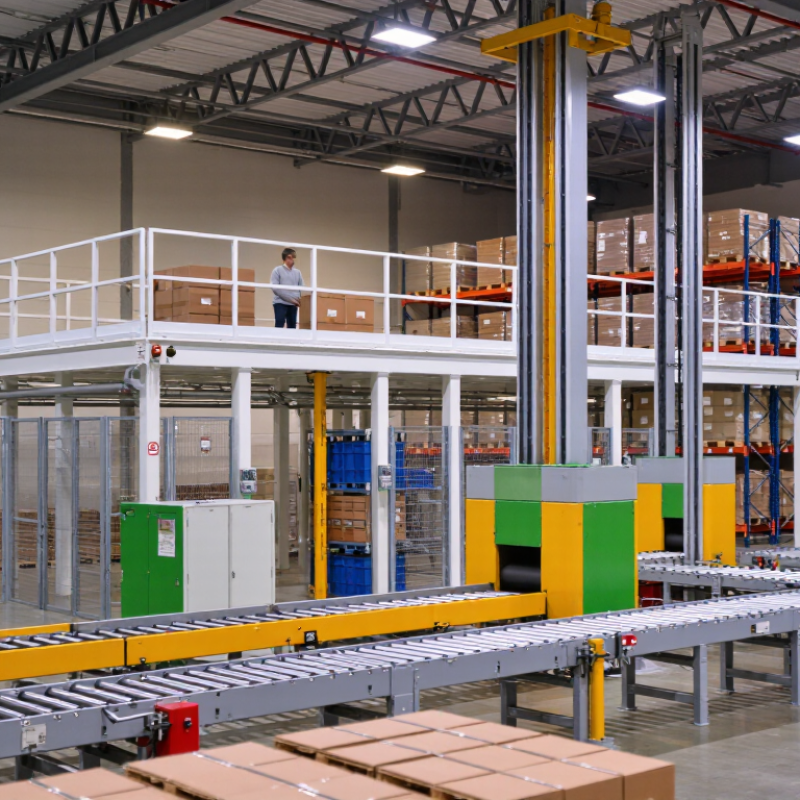
A vertical lift conveyor moves cartons between floor levels without using valuable ramp space. Its working principle is straightforward. A motor drives chains, belts, or rollers connected to a lifting platform. When a carton reaches the entry zone, sensors confirm its position. The platform then rises or descends along guided rails. At the destination, rollers transfer the load to the next conveyor section.

The controller manages speed, stops, and access doors. Safety interlocks should prevent movement when a gate remains open. In real facilities, alignment matters more than glossy specifications. A small height difference can cause cartons to jam. The MHI 2024 Annual Industry Report reported that 55% of respondents were increasing investment in supply chain innovation. This supports automation, but it does not remove the need for careful site testing. A lift must match product weight, dimensions, traffic frequency, and available headroom. It is not magic.

Tips: Measure the tallest carton first. Check the heaviest load dynamically, not only at rest. Leave maintenance clearance around the platform. Test uneven loads, loose packaging, and emergency stops before daily operation. ISO 12100 risk-assessment principles can guide hazard identification, though local codes still require review. I have seen poorly positioned sensors create repeated stops, wasting more time than the lift was meant to save.η

Which Materials and Industries Benefit Most?

Vertical lift conveyors suit facilities that move cartons, totes, pallets, drums, or small parts between floor levels. They use vertical space instead of demanding another long conveyor line. That difference matters in crowded plants.

E-commerce distribution centers often handle mixed cartons and reusable totes. The U.S. Census Bureau reported that e-commerce represented 16.1% of total U.S. retail sales in 2024. That volume creates frequent elevation changes near picking, packing, and dispatch areas. A lift can connect mezzanines with fewer manual transfers. It can also reduce walking around fixed stairways.

Quietly useful.

Manufacturers benefit when automotive parts, packaged food, or consumer goods move between production stages. Food facilities need washable surfaces and careful segregation. Pharmaceutical operations need documented cleaning, controlled access, and reliable tracking. These requirements can make lift selection more demanding than expected. MHI’s 2024 Annual Industry Report found that 55% of supply-chain leaders planned to increase technology and innovation investment. Automation is gaining attention, but it is not automatically suitable.

I would not specify a lift from throughput alone. Product dimensions, load stability, temperature, sanitation, and transfer height must be tested together. A poorly matched conveyor may create stoppages at every level. The better choice is often the less impressive one: simple, accessible, and easy for operators to inspect.

What Are the Key Advantages for Material Handling?

Why Choose a Vertical Lift Conveyor for Material Handling?

Vertical lift conveyors move cartons between floor levels without consuming a long ramp. In busy facilities, that simple change can release valuable aisle space. Operators gain shorter travel paths. A lift can create a clear, repeatable handoff between receiving, storage, and dispatch. This consistency matters when hourly demand changes or staffing becomes tight. Less walking may reduce fatigue, although it does not replace safe work practices.

Controlled lifting can help protect products from rough manual handling and unnecessary transfers. Enclosed platforms also keep loads contained during vertical movement. With guards, sensors, and emergency stops, the equipment can support a safer workflow. However, safety depends on correct installation, training, and routine inspection. Teams should check gates, sensors, chains, belts, and stopping functions at planned intervals. Small faults become expensive when ignored.

From a maintenance perspective, a well-designed lift offers accessible service points and predictable movement. It can connect conveyors across multiple levels while preserving a compact layout. Energy use may remain reasonable when the system matches the load, speed, and duty cycle. Yet a poorly sized conveyor can create delays, noise, or unnecessary wear. Engineers should review product dimensions, weight, cycle rate, floor openings, and operator access before installation. Real site measurements matter. A vertical solution is not automatically the best solution.

Why Choose a Vertical Lift Conveyor for Material Handling?

Vertical lift conveyors provide controlled vertical transport between floors or process levels while reducing manual handling and preserving valuable floor space. The chart shows common planning ranges for non-branded vertical lift conveyor applications.

Actual performance depends on load size, carrier design, lift height, safety requirements, and system layout. Typical values shown are general industry planning ranges rather than manufacturer-specific specifications.

How to Choose the Right Vertical Lift Conveyor?

Why Choose a Vertical Lift Conveyor for Material Handling?

How to Choose the Right Vertical Lift Conveyor?

Selecting a vertical lift conveyor starts with the load, not the catalog photo. Record product weight, dimensions, center of gravity, and daily cycle volume. A carton that feels stable at floor level may shift during acceleration. Measure every landing height and confirm the required transfer direction. The system should match your building, not force expensive structural changes. The MHI 2024 Annual Industry Report found that 74% of supply chain leaders planned to increase technology investment, but investment alone does not fix poor process data.

Throughput deserves careful testing. Ask for rated cycles per hour under your actual load, not an empty-platform demonstration. Check lift speed, transfer time, noise, guarding, emergency stops, and access for cleaning. Safety-related controls should follow applicable workplace requirements, while interlocks should prevent door opening during movement. For dusty, cold, or humid areas, specify suitable materials and protection levels. A professional site survey should also review floor strength, ceiling clearance, fire protection, and maintenance access.

Do not ignore integration. Confirm communication with scanners, warehouse software, and upstream conveyors before purchasing. The 2024 World Robotics report from the International Federation of Robotics recorded 541,302 industrial robot installations in 2023, showing stronger automation adoption across industry. Still, automation can create a bottleneck if upstream stations feed faster than the lift can handle. I would request a simulation or monitored trial. The “best” conveyor may be slightly slower, easier to service, and more reliable. That trade-off is easy to underestimate.

Skip to content