2026 Best Carbon Fiber Production Line Cost Guide
Planning a carbon fiber facility begins with one difficult question: what does the equipment really cost? The answer depends on production volume, precursor type, energy demand, automation, and quality targets. A small pilot line may fit inside an existing factory. A commercial line can require multiple buildings, specialized furnaces, and extensive utility upgrades.
As composites manufacturing researcher Dr. John W. Gillespie Jr. has stated, “Manufacturing cost is not a single number; it is a chain of decisions.” That idea shapes this 2026 guide. Carbon fiber production line cost includes more than spinning and carbonization equipment. It may cover precursor preparation, stabilization ovens, carbonization furnaces, surface treatment, sizing, winding, inspection, installation, and commissioning. The details matter.
A useful estimate needs physical evidence. Think of furnace length, gas flow, power capacity, floor loading, and daily output. Each item can change the investment. Energy prices may also reshape the operating budget. Quickly. Some online estimates look precise but hide transport, factory adaptation, maintenance, or workforce training. That is a weakness worth acknowledging.
This guide compares major cost drivers, realistic investment ranges, operating expenses, and capacity choices for 2026. It also examines where projects commonly exceed their budgets. Readers should treat every figure as a planning reference, not a guaranteed quotation. Supplier specifications, regional labor rates, and local engineering conditions must be verified before purchasing. Mistakes happen. Careful assumptions reduce them.
Carbon Fiber Production Line: Process Overview and Core Equipment
Carbon Fiber Production Line: Process Overview and Core Equipment
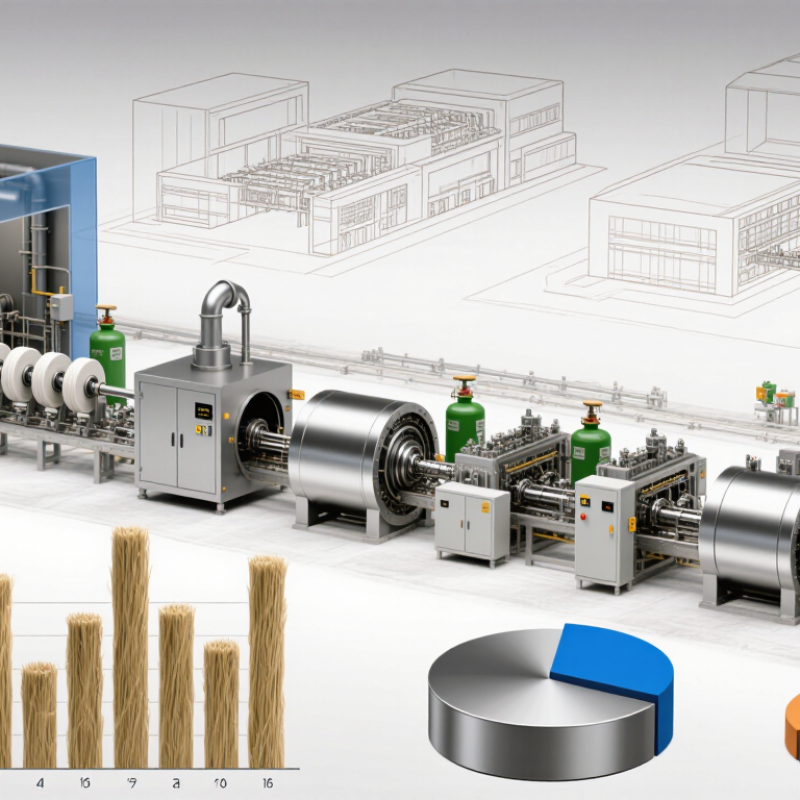
A carbon fiber line begins with polyacrylonitrile, or PAN, precursor. The yarn passes through oxidation ovens at about 200–300°C. Stabilization changes its molecular structure. Carbonization then occurs in inert furnaces, commonly between 1,000°C and 1,500°C. Small temperature variations can affect tensile strength, elongation, and surface quality.
Core equipment includes creels, tension controllers, oxidation ovens, carbonization furnaces, surface-treatment tanks, sizing units, dryers, and winding machines. Exhaust treatment is essential because ovens release volatile compounds. According to the 2024 Carbon Fiber Market report by MarketsandMarkets, the global market was estimated at approximately USD 3.7 billion in 2023 and is projected to reach about USD 5.0 billion by 2028. That growth increases pressure on stable, scalable production systems.
Energy deserves close attention. Furnace insulation, gas circulation, and heat recovery can strongly influence operating cost. U.S. Department of Energy and Oak Ridge National Laboratory studies have examined textile-grade PAN as a lower-cost precursor route. However, lower input cost does not automatically mean better fiber. It may reduce consistency. A practical line needs online tension monitoring, temperature mapping, and regular tensile testing. Perfect uniformity is difficult. Production data should guide adjustments, not optimistic equipment brochures.
2026 Best Carbon Fiber Production Line Cost Guide - Carbon Fiber Production Line: Process Overview and Core Equipment
Indicative 2026 budgetary data for a new PAN-based carbon fiber production line. Costs are shown in USD and represent typical equipment, installation, commissioning, and process-integration ranges for industrial projects.
| Process Stage | Core Equipment | Primary Function | Typical Operating Parameters | Indicative Capacity | Estimated Equipment Cost | Estimated Installed Cost | Typical Lead Time |
|---|---|---|---|---|---|---|---|
| 1. PAN Precursor Preparation | Acrylonitrile feed system, comonomer dosing unit, polymerization reactors, solvent recovery system | Produces PAN polymer with controlled molecular weight and comonomer content for spinning. | Polymerization temperature: approximately 60–80°C; solid content: commonly 15–25%; continuous or batch operation | 1,000–5,000 tonnes of PAN precursor per year | $8–25 million | $14–40 million | 14–24 months |
| 2. Wet-Spinning System | Spinning pumps, spinnerets, coagulation baths, washing units, stretching rollers | Converts PAN dope into continuous precursor filaments with a uniform cross-section. | Typical filament count: 1K–50K; multi-stage stretching ratio: approximately 3–10× | 1,000–5,000 tonnes per year | $5–15 million | $9–24 million | 12–20 months |
| 3. Precursor Washing and Finishing | Counter-current washing tanks, drying rollers, finish applicator, tension-control system | Removes residual solvent and applies a surface finish to improve handling and conversion stability. | Residual solvent target: typically below 1%; controlled yarn tension and moisture content | Continuous tow operation | $1.5–5 million | $3–8 million | 10–16 months |
| 4. Oxidation or Stabilization | Multi-zone oxidation ovens, hot-air circulation units, exhaust treatment, tow guidance system | Stabilizes PAN fibers through controlled cyclization, dehydrogenation, and oxidation before carbonization. | Temperature profile: approximately 200–300°C; residence time: commonly 30–120 minutes | 500–3,000 tonnes of carbon fiber per year | $4–12 million | $8–20 million | 14–22 months |
| 5. Low-Temperature Carbonization | Inert-atmosphere furnaces, nitrogen supply system, sealed tow paths, temperature-control panels | Removes most non-carbon elements and forms a carbon-rich fiber structure. | Operating temperature: approximately 600–1,000°C; oxygen concentration kept very low | 500–3,000 tonnes per year | $5–16 million | $10–27 million | 16–24 months |
| 6. High-Temperature Carbonization | High-temperature furnaces, graphite or ceramic heating zones, inert-gas recirculation and purification | Increases carbon content, tensile strength, and modulus of the fiber. | Standard-grade carbon fiber: approximately 1,200–1,600°C; higher-modulus grades may require 2,000°C or more | 500–3,000 tonnes per year | $7–22 million | $14–36 million | 18–28 months |
| 7. Surface Treatment | Electrochemical treatment cells, electrolyte circulation, rectifiers, rinse and filtration units | Modifies the fiber surface to improve adhesion with epoxy, polyester, and other resin systems. | Controlled current density; treatment chemistry selected for the target resin system | Continuous tow processing | $1–4 million | $2.5–7 million | 10–16 months |
| 8. Sizing Application | Sizing bath or spray applicator, metering rollers, drying oven, concentration-control system | Applies a compatible protective coating to reduce fuzz, improve handling, and support composite processing. | Sizing add-on: commonly 0.5–2.0% by fiber mass; drying temperature generally below 200°C | Continuous tow processing | $0.8–3 million | $1.5–5 million | 8–14 months |
| 9. Drying, Spooling, and Packaging | Final drying ovens, precision winders, tension controllers, spool handling and packaging equipment | Packages finished carbon fiber into stable, accurately tensioned spools or tows. | Winding tension controlled according to tow size; common package weights: 5–25 kg | 500–3,000 tonnes per year | $1–4 million | $2–7 million | 8–14 months |
| 10. Process Control and Quality Laboratory | PLC/SCADA system, tension monitoring, diameter measurement, tensile tester, microscopy, moisture and ash analysis | Maintains process stability and verifies tensile strength, modulus, elongation, sizing level, and surface quality. | Online monitoring combined with laboratory testing and statistical process control | Supports the complete production line | $1–5 million | $2–8 million | 10–18 months |
| 11. Utility and Environmental Systems | Nitrogen generation, cooling water, chilled water, compressed air, thermal oil, exhaust oxidation and filtration | Provides stable utilities and controls solvent vapors, volatile compounds, heat, and process emissions. | Utility demand depends on line capacity, furnace design, energy recovery, and local regulations | Designed for the selected line capacity | $6–20 million | $12–35 million | 14–26 months |
| Estimated Total for an Integrated PAN-Based Carbon Fiber Line | $41.3–131 million | $78–217 million | 18–32 months | ||||